
Tags
agile, brigitte maenhout, business process, business value, cognitive psychology, drive, economic success, empowerment, experiment, flow, happiness, highly efficient teams, scrum, scrum master, self-development
Agile is so effective because it has a lot of hidden tools in it that work. Surprisingly, a lot of the scrum masters and even Agile coaches that I have come across don’t talk about these things. Some don’t know about them, some choose not to reveal them, some even think it’s not part of their job to care….
But, I am a strong believer in clarity, as clarity creates meaning, meaning creates purpose and purpose is one of the corner stones of motivation, which ultimately leads to higher efficiency and thus, higher business value.
When people know the WHY, they will follow, they will learn, they will care. ( why do you think the most successful leaders focus on WHY and not HOW )
I am going to talk a little bit on how I do refinement. Not saying it’s the most effective way and you SHOULD be doing it like this, no, you have your team, you have your style, you will learn what works. But, I do want to show you what has been very successful for me and my teams.
REFINEMENT PHASE 1:
– I have 2 refinements, for a 2 week sprint, in the middle of each week. They are 2 hours long at the moment, because our team is not fully aligned yet. They will become less time consuming over time. But you look at your team and at your needs.
Take a look at this MVP drawing I did on the train this morning, this is the visual representation of my refinement ( phase 1 = week 1) – the second refinement is slightly different, but more on that later.
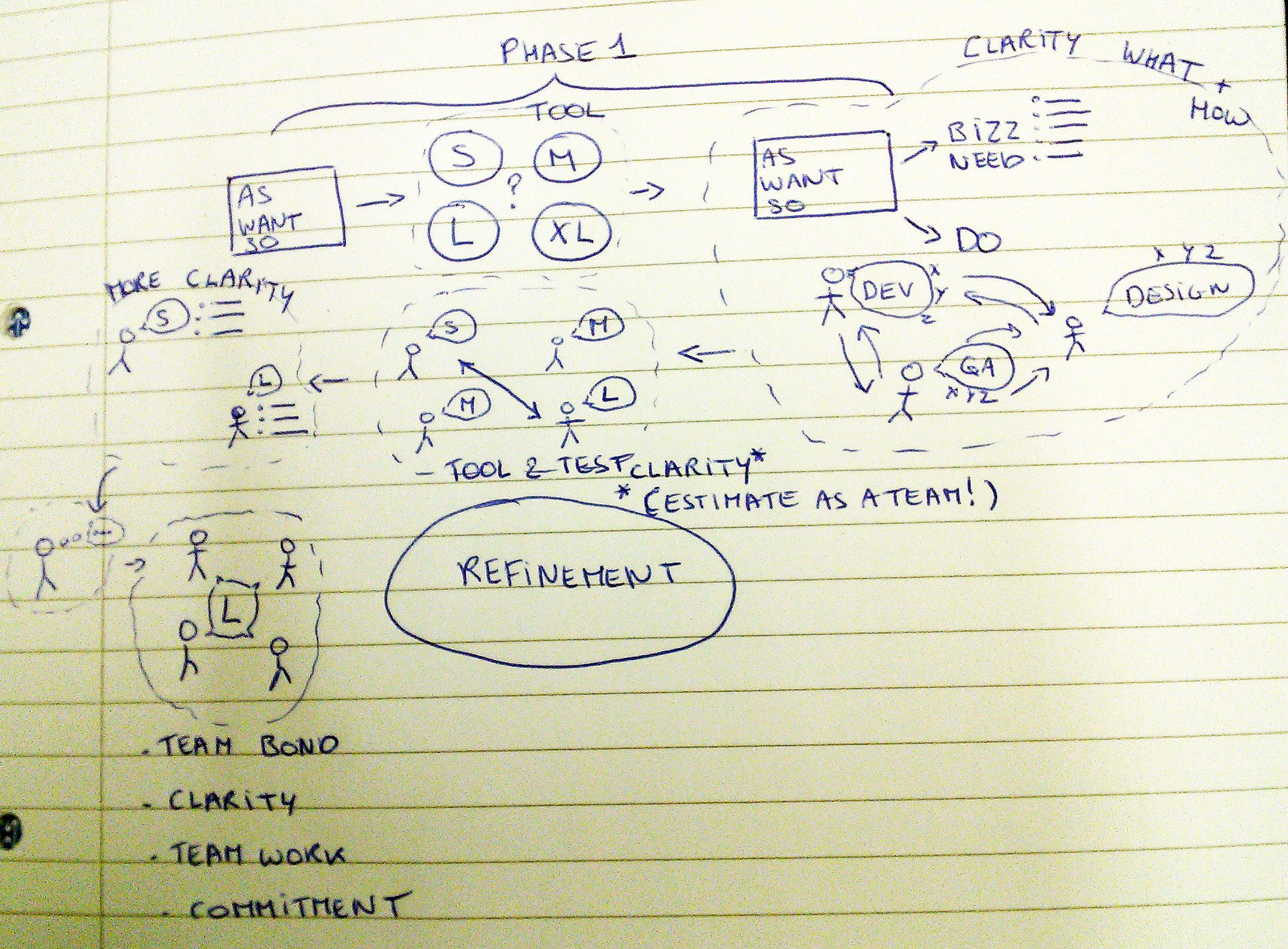
Agile refinement Phase 1
Phase 1:
Input ==> Prioritised backlog of cards
Iteration per card:
- Use a visual reminder of what we are trying to get to: estimation in T-shirt size. (WHY? Are the estimations that important? They are important for different reasons, but one of the hidden gems will become clear when you read on, it’s a tool to make sure the team is on the same page and to create more x-functional mindset)
- Ask the PO and the team for clarity on 2 subjects: Business requirement and the detail of what they need/want + How the team thinks of tackling this ( on a high level ) – PO should not interfere with the how, but in my team, he does have a voice and we can openly discuss things because it aids in cooperation and x-functional nature of the team, it brakes down tribes and creates a vibe of truly working together to create business value. BUT… in some teams, you CANNOT do it. If you have a PO with the tendency to micromanage, do not give them a voice until you have coached them into being more efficient.
- SM: Do we, as a team, have a clear enough understanding of what is involved to do a high level estimation? Yes? OK, 3,2,1 – estimate!!!
- If you notice a big diversity of estimation, it means one of 2 things: 1. your team is not estimating as a team (yes, I ask them to estimate as a team, because it has proven much more efficient – promotes x-functional, understanding of each others challenges, they become a more tight business unit and less risk of silo-ing) or 2. There is a level of un-clarity.
- SM: Person Small – Why? Person Large – Why? : You ask the extremes to make their cases, the team chips in when they do and the blanks get filled in, the misunderstandings surface and the team reaches a mutual agreement.
- Re-estimate.
- All on same level – great, we all know what to do on a high level, we have surfaced effort, complexity and our level of understanding to PO and we have done it as a team, ready to go for it and deliver that business value!!! 🙂
So the hidden gems:
- Estimation as a team creates understanding and respect for each others challenges
- It’s the basis of x-functional
- It highlights where there is misunderstanding
- It highlight areas of improvement in individuals and teams ( is someone constantly estimating too high? Why is that? lack of confidence? more experienced, so they know what is REALLY involved? Tendency to be to perfectionist and not lean enough – depends on case by case of course, sometimes perfection is needed…)
- It creates a common purpose, the basis of mastery and… they did it all themselves ( autonomy – growth ,…) => basis of motivation ( autonomy, mastery, purpose)
I actually use bright coloured cards with cardboard 3D letters of S, M, L, XL and the physical cards. We have everything in JIRA too, but screens are banned during that meeting… all for a reason.
Why a tangible visual? Cognitive psychology has shown us an insight in how our brain works, the more we understand it, the more we should use that knowledge to find the most effective communication tools. The brain creates meaning through the senses. Visual is one of those senses. Our primary visual cortex picks up basic shapes initially ( circles or squares ) it relais info to the other areas in our brain: Ventral stream, Dorsal stream and limbic system. Respectively for the WHAT (its a card, its a letter), the location of the body in space and the feeling, gut, strong emotional reaction.
I use all of the above to add to the experience, and why not? science it there to use, not just to be interested in. Win-wins for the win 😉
And… it works. You actually see it during refinement, people are more involved, they stand, they sit, the move around, the physically move the cards… it helps embed all the info and associated info in the brain…
We’ve got the tools, we’ve got the knowledge,… use them, explore them, improve them 🙂
 Brigitte Maenhout