• About

Brigitte Maenhout

~ Life is learning while adding value

Brigitte Maenhout

Tag Archives: empowerment

Hidden gems in retro – learn from history to improve in the future

13 Thursday Nov 2014

Posted by Brigitte Maenhout in Agile Scrum, Highly efficient teams

≈ Leave a comment

Tags

agile, brigitte maenhout, business value, cognitive psychology, economic success, empowerment, highly efficient teams, personal development, retro, retrospective, scrum

speedboat

In my native language, we have a saying: ‘EEN EZEL STOOT ZICH GEEN TWEEMAAL AAN DEZELFDE STEEN!‘ Loosely translated it means:  ‘A donkey doesn’t trip twice over the same rock.’

So basically, you are an idiot if you make the same mistake twice. In real life, planet earth seems to be populated with idiots and I must admit, on occasion, I am one of them.

Why? Cause we don’t take the time to stop and look around to see what rock actually made us trip. Or we just assume tripping is part of our natural behaviour. Or we know the rocks that make us trip, we know they shouldn’t be there but we accept that there is nothing we can do. Or maybe we are even to scared to look if there are any other paths that would allow us to avoid the rocks? There are so many other variants that stop us from making the same mistakes twice and ultimately, stop us from improving.

So that is why we have retro’s. A brief moment to stand still, look at what went well, what didn’t go that well. There are 2 parts: Identify (inspect) and plan to improve (adapt) – tip: develop your own personal retro. I do that all the time, take some time to just sit and ask myself the questions what I like about my behaviour, where I can improve,…

There are plenty of techniques out there and different ways to get to the same result. At the moment, with my current team I use a technique that the previous scrum master used and I added in: start, stop, continue.

The retro’s are good at the moment, our team has gotten used to them and is slowly understanding the value of surfacing issues in a diplomatic way. Hopefully in the future, we will reach a level where we don’t even need diplomacy any more, just respect, but at the moment, we aren’t there yet. So what does the retro look like? Every one gathers in the meeting room, they can sit, stand, walk around, whatever is comfortable. And we start by asking every one to give us 2 words of what they felt last sprint. To give some examples, sometimes words like these surface: ‘lots of fun’ (yes 3 words, but I’m flexible with the number 😉 or ‘very bored’ or ‘cautiously optimistic’. I write them on the board, in a mind map with the initials next to them of who said what. – the reason I use mindmap is: I want my team to understand the value of approaching emotions or concepts in an analytical way. This mindmap will usually be on the left side of the board.

Once I have gotten the words, I draw a table on the right side of the board:  start, stop, continue this will lead to the conclusions. Showing the team that what they analyse immediately reflects into valuable improvement areas.

Then I go back to the left side and pick one member out and get them to explain more in detail what their words mean. It’s great fun, wherever we can, we keep it light, even when the words are more loaded, because it is important to show that we are looking at problems that people have, the problems are the issue, not the people.

Retro’s are fun, why? Neuroscience has given us enough info to know what fun does to our brain, eliminates stress, actually grows neurons, bottom line, makes us smarter in the most efficient way. We come out of a retro energized, even if we tackled hard topics.

I usually also embed some coaching in my retro’s where I need to, you plant the seeds, the team runs with it and you see the individuals improve!

Don’t get me wrong, retro’s are in my opinion the hardest, it requires a lot of skills to see what approach to take to get the best out of your team and what approach to take towards every individual. Because I have rarely seen teams that are on the same level of experience, maturity,…

But, they are the most valuable, THIS is where you IMPROVE, add tremendous value to the business ( improve process, individual and team)… if you do it right.

Now go out and play!!!

🙂

PS: If you want to know about other techniques, look up 4L, play boat, mad sal glad, quartering, silent writing (if you need help with establishing safety),…
The hidden gems of refinement – phase 2

06 Thursday Nov 2014

Posted by Brigitte Maenhout in Agile Scrum

≈ Leave a comment

Tags

agile, autonomy, brigitte maenhout, business value, caring, cognitive psychology, economic success, empowerment, Lean, mastery, purpose, scrum, scrum master

This is part 2 of the hidden gems in refinement, you will find part 1 as the previous post on my blog.

Part 2 of refinement continues as part 1 if you did not manage to finalise part 1 in the first refinement. ( get all stories estimated in T-shirt sizes ) -ultimately, the t-shirt sizing is good enough to start your sprint planning, but I always try to add another level and dig a bit deeper in the stories if time allows it. The sooner we spot potential issues, the sooner we can do something about it.

So, Part 2 is  all about refining further and at the same time, revisiting the stories to get them in every team members mind. Did you know that the way the stories are written ( AS A [PERSONA] I WANT TO […] SO THAT […] ) to be optimised for sucking the information up in your brain? Like songs, we remember stories easier than de-coupled words. So I guess the next step up for remembering stories will be creating song cards, but I haven’t gone that far yet with my scrum master experiments, maybe one day 😉

Also the format is there to really make you think about why you are building what you are building, you you are creating it for and what it actually is that you are creating. This  triggers usually other areas of thoughts/requirements that might have slipped through the net if you didn’t take the trouble to write the as, what, so format. (As a scrum master, make sure that people do THINK about it, and not just use the format without thinking… trust me, it does happen…)

Do we write out the whole format on the card? No, as with everything, nothing is black and white, you need to THINK. What does my team need? Visibility, clarity and to understand the meaning behind it. If you are trying to fit AS a forgetful user I want to… on a card, it looks visually cluttered. So to fix that, I am using a visual persona ( stickfigure with a legend, most of our persona’s are re-occurring anyway so every one gets to know our actors )  I leave out or abbreviate the i want to and the so that is optional anyway, but when I use it, it gets abbreviated or replaced by an arrow ( especially when I am working with a techy  team, arrows is part of their alphabet)

Now back to phase 2 refinement.

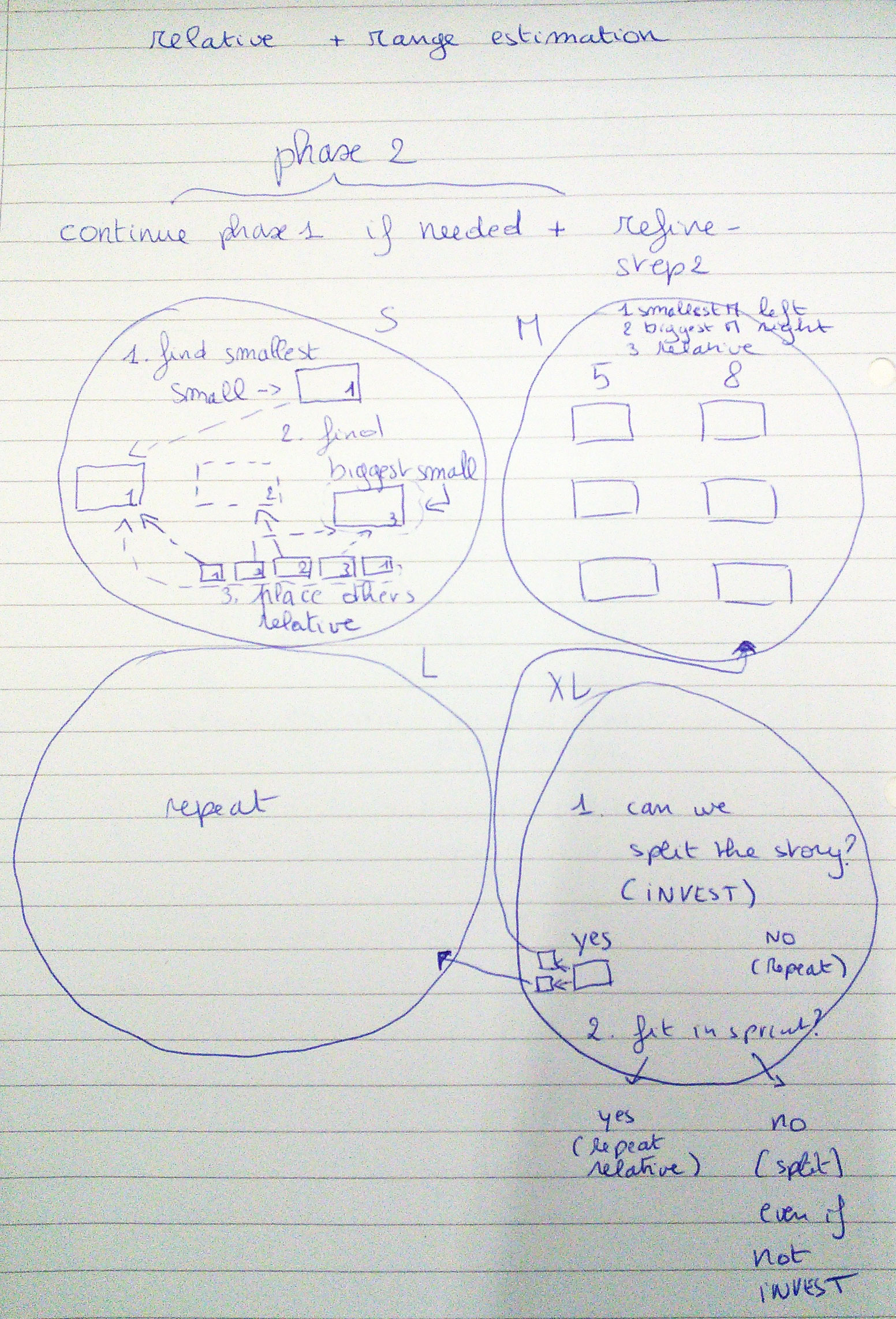
This is what it looks like:

Agile refinement phase 2

Agile refinement phase 2

From refinement phase 1, you got to put the stories into T-shirt sized bubbles. Now it’s time to take the relativity one step further.

For every bubble:

  1. Find the smallest piece of work put it to the left of the bubble
  2. Find the biggest piece of work, put it to the right of the bubble
  3. Look at the other cards and put them relative to each other.

For small, you have 3 areas to use (LEFT = 1 user story point, MIDDLE = 2 user story points, RIGHT = 3 user story points)

For the others, you only have 2 columns ( LEFT and RIGHT )

Why do we have 3 options for small and less for medium (5,8), Large (13,21), XL (34,55): The smaller an item, usually, the easier it is to predict the effort so you can have more precise ranges. The more complex, the bigger the ranges ( so they can hold more diverse cards – when it comes to effort. BTW effort = TIME * people)

XL, is another kettle of fish… If an item is XL, find out why. Is it really too big or too unclear or a bit of both? Can we split it out following INVEST? If you can- do so and re-organise the cards. Will it fit into a sprint? if No, then you need to split the card even if it doesn’t follow INVEST, I know there is not a lot of info out there on these scenario’s but, Agile looks at reality, so reality needs to be reflected at all times. Use pragmatism in these cases, that has always worked well for me. But to be honest, it’s very rare that we can’t find a way following INVEST to make it fit into a sprint.

So what are the hidden gems?

  • Individual level => Brain-training + efficiency training due to format of cards and repetition
  • team work as always – they work together deciding smallest, biggest,… it is amazing to see a team really do this together, they form a bond!
  • commitment and autonomy. The team has estimated this, it’s them saying: we can do this, and we feel confident it will take us this amount of effort. => motivation!

I hope you enjoyed this 🙂

Thank you and see you next time!

Brigitte

The ‘so that’ of refinement.

05 Wednesday Nov 2014

Posted by Brigitte Maenhout in Agile Scrum

≈ Leave a comment

Tags

agile, brigitte maenhout, business process, business value, cognitive psychology, drive, economic success, empowerment, experiment, flow, happiness, highly efficient teams, scrum, scrum master, self-development

Agile is so effective because it has a lot of hidden tools in it that work. Surprisingly, a lot of the scrum masters and even Agile coaches that I have come across don’t talk about these things. Some don’t know about them, some choose not to reveal them, some even think it’s not part of their job to care….

But, I am a strong believer in clarity, as clarity creates meaning, meaning creates purpose and purpose is one of the corner stones of motivation, which ultimately leads to higher efficiency and thus, higher business value.

When people know the WHY, they will follow, they will learn, they will care. ( why do you think the most successful leaders focus on WHY and not HOW )

I am going to talk a little bit on how I do refinement. Not saying it’s the most effective way and you SHOULD be doing it like this, no, you have your team, you have your style, you will learn what works. But, I do want to show you what has been very successful for me and my teams.

REFINEMENT PHASE 1:

– I have 2 refinements, for a 2 week sprint, in the middle of each week. They are 2 hours long at the moment, because our team is not fully aligned yet. They will become less time consuming over time. But you look at your team and at your needs.

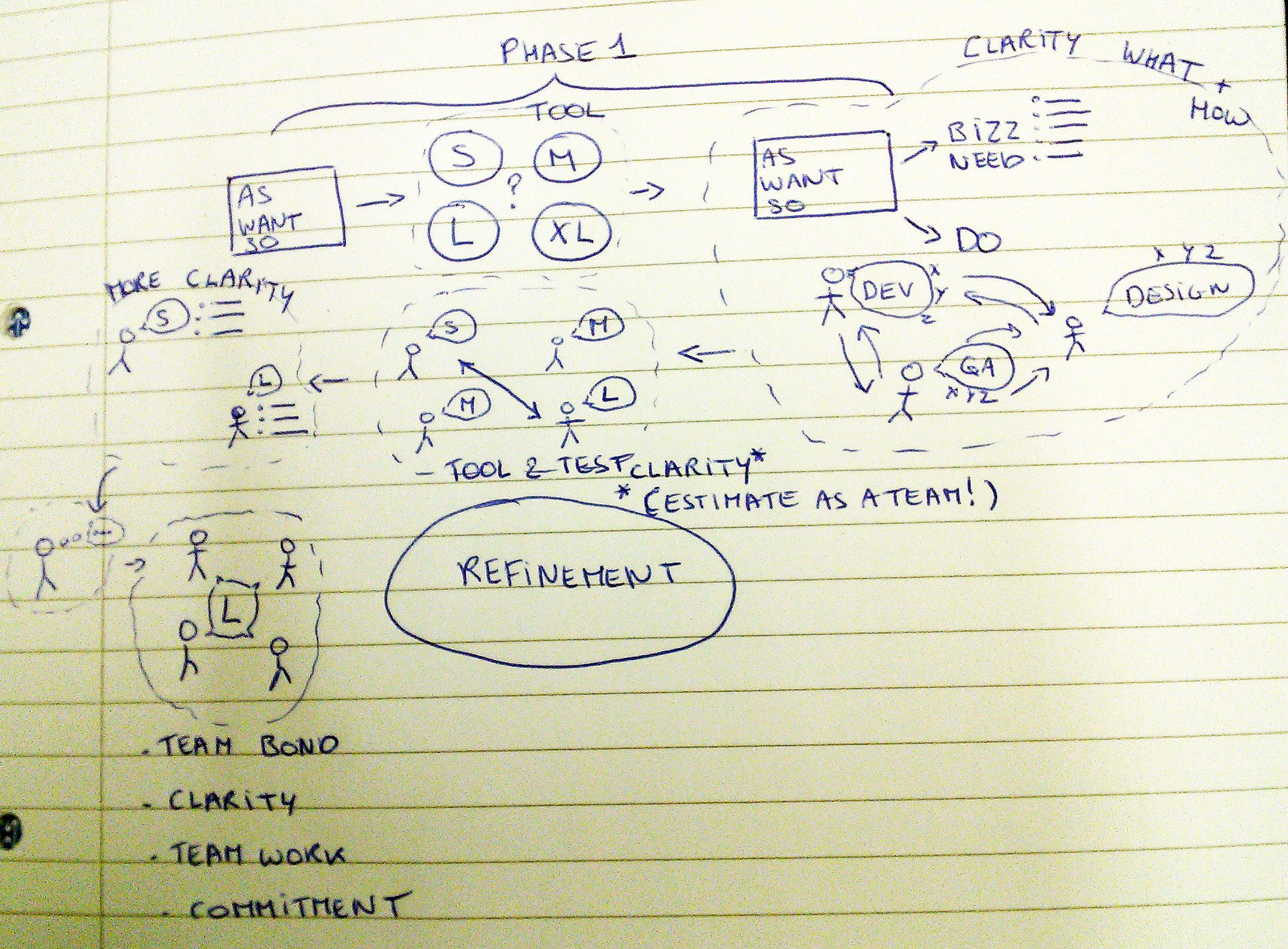
Take a look at this MVP drawing I did on the train this morning, this is the visual representation of my refinement ( phase 1 = week 1) – the second refinement is slightly different, but more on that later.

Agile refinement Phase 1

Agile refinement Phase 1

Phase 1:

Input ==> Prioritised backlog of cards

Iteration per card:

  1. Use a visual reminder of what we are trying to get to: estimation in T-shirt size. (WHY? Are the estimations that important? They are important for different reasons, but one of the hidden gems will become clear when you read on, it’s a tool to make sure the team is on the same page and to create more x-functional mindset)
  2. Ask the PO and the team for clarity on 2 subjects: Business requirement and the detail of what they need/want + How the team thinks of tackling this ( on a high level ) – PO should not interfere with the how, but in my team, he does have a voice and we can openly discuss things because it aids in cooperation and x-functional nature of the team, it brakes down tribes and creates a vibe of truly working together to create business value. BUT… in some teams, you CANNOT do it. If you have a PO with the tendency to micromanage, do not give them a voice until you have coached them into being more efficient.
  3. SM: Do we, as a team, have a clear enough understanding of what is involved to do a high level estimation? Yes? OK, 3,2,1 – estimate!!!
  4. If you notice a big diversity of estimation, it means one of 2 things: 1. your team is not estimating as a team (yes, I ask them to estimate as a team, because it has proven much more efficient – promotes x-functional, understanding of each others challenges, they become a more tight business unit and less risk of silo-ing) or 2. There is a level of un-clarity.
  5. SM: Person Small – Why? Person Large – Why? : You ask the extremes to make their cases, the team chips in when they do and the blanks get filled in, the misunderstandings surface and the team reaches a mutual agreement.
  6. Re-estimate.
  7. All on same level – great, we all know what to do on a high level, we have surfaced effort, complexity and our level of understanding to PO and we have done it as a team, ready to go for it and deliver that business value!!! 🙂

So the hidden gems:

  • Estimation as a team creates understanding and respect for each others challenges
  • It’s the basis of x-functional
  • It highlights where there is misunderstanding
  • It highlight areas of improvement in individuals and teams ( is someone constantly estimating too high? Why is that? lack of confidence? more experienced, so they know what is REALLY involved? Tendency to be to perfectionist and not lean enough – depends on case by case of course, sometimes perfection is needed…)
  • It creates a common purpose, the basis of mastery and… they did it all themselves ( autonomy – growth ,…) => basis of motivation ( autonomy, mastery, purpose)

I actually use bright coloured cards with cardboard 3D letters of S, M, L, XL and the physical cards. We have everything in JIRA too, but screens are banned during that meeting… all for a reason.

Why a tangible visual? Cognitive psychology has shown us an insight in how our brain works, the more we understand it, the more we should use that knowledge to find the most effective communication tools. The brain creates meaning through the senses. Visual is one of those senses. Our primary visual cortex picks up basic shapes initially ( circles or squares ) it relais info to the other areas in our brain: Ventral stream, Dorsal stream and limbic system. Respectively for the WHAT (its a card, its a letter), the location of the body in space and the feeling, gut, strong emotional reaction.

I use all of the above to add to the experience, and why not? science it there to use, not just to be interested in. Win-wins for the win 😉

And… it works. You actually see it during refinement, people are more involved, they stand, they sit, the move around, the physically move the cards… it helps embed all the info and associated info in the brain…

We’ve got the tools, we’ve got the knowledge,… use them, explore them, improve them 🙂

Agile, the road to a new society where productivity and happiness soar hand in hand.

19 Friday Sep 2014

Posted by Brigitte Maenhout in Agile Scrum

≈ Leave a comment

Tags

agile, brigitte maenhout, business process, business value, economic success, empowerment, happiness, highly efficient teams, scrum, scrum master

Isn’t it clear? I don’t think it is clear for everyone how much Agile can contribute to the biggest necessity in the future of this society. Let me shed some light on that.

I love analysing stuff, always loved it, even from when I was a little girl. My parents told me a story from when I was about 5 years old. I had gotten hold of their alarm clock and I was taking it apart. When they asked me why, I said I wanted to know how it worked. I haven’t changed much since then, but instead of taking apart alarm clocks, I take apart processes, society and people. I can’t help it… at my core, I am an analyst.

Why do I do it? Curiosity and a desire to understand so that I can help improve. And isn’t that a little bit what Agile does? You look at what is reality, you inspect, and seek how you can continuously improve.

It’s the only way, one of the many purposes of life is growth, we continuously evolve, whether we want to or not, it’s part of our nature. The way we grow, that’s up to us, we are the masters of our destiny, because even though we can’t predict what is going to happen, but we are the master of how we react to it. And our reactions might not always be the most optimal, we can only shape our lives in a more efficient way when we learn to understand and evolve our reactions ( inspect and adapt ).

As a society as a whole, you must have noticed we are facing a severe problem, depression, disease, demotivation, unhappiness. What is life when you are living it in those circumstances? And at the same time, you try to keep your family fed, your relationships alive and a roof over your head. The pressures of work seem to rise and rise. And instead of businesses taking responsibility over their most valuable resource, what often happens is that they try and put a plaster over a gushing wound and send them back into battle. It’s not the right way, this is a typical example of loose-loose.

Agile provides us with an answer to win-win. It’s based on the core principals of decent human beings. You know, you can trust them. It’s like your kids growing up, at a certain time, you need to let them be their own person, responsible for their destiny and trust that they will do the right thing. Same with the people working for you, people care. They care about their work and they want to do a good job (there are always exceptions, but that is what they are, exceptions, not the majority)

The more you give people the freedom to contribute to your product, make it part of what they are passionate about, make it theirs… the more you will see productivity, innovation and creativity soar. And at the same time, happiness will go up.

I think we have only just scratched the surface of what we can do with Agile, I think we can take it much further than just letting teams organise their work, I am a strong believer that we should experiment with having teams determine to the fullest how they work. This means work hours, rewards, holidays,… I know some companies are already experimenting with this… but the way you do it, is, like in a family, in a safe environment where you continuously look back, review, adapt, grow.

If we follow this approach, I am convinced that we will reduce costs, increase happiness for the people at work but also in their immediate family, which will again have a side effect on other companies and people.

Will this be an easy road, no, it won’t be and you need the right people to guide the way, if you want to do this experiment, you will need a brilliant scrum master, a PO and a team who are mature enough. But if you do take this journey, you will most certainly have a huge competitive advantage.

Yours truly,

Brigitte

Explosions are imminent

16 Tuesday Sep 2014

Posted by Brigitte Maenhout in Agile Scrum

≈ Leave a comment

Tags

agile, business process, business value, economic success, empowerment, highly efficient teams, kanban, Lean, resource management, scrum, scrum master

I have seen it countless times, when faced with a challenge, people, businesses, revert to old, known behaviour. It takes courage to actually stand still, investigate what is right and be brave enough to implement it.

At my current company, we have had a huge success with Agile. When the CTO made the courageous decision to hire a completely new team and a very talented Agile Coach/scrum master, and took on a new project ( with a deadline ) he knew that he was setting himself up for success. And that is what happened. Not only did he deliver in time, the product was delivered with high-quality, by a happy, self organised team.

The last sprint goal was: keep calm. And that was it. Never before had I, or any other team member been in a live release that was so calm and effective, it was almost surreal and it showed us all what Agile can do.

That, was only scratching the surface and it wasn’t even SCRUM to the letter, as with most projects, in reality, there is a balance to be found, it’s continuous improvement, it’s transition towards Agile. But even in this setting, these were some of the side effects.

The team members were actually happy, a sight that you don’t often see in a place of work. Even though countless studies have shown the immense importance of happiness on productivity, loyalty, drive and creativity.

The team had clarity and transparency, again, not 100% but the trust is there, the basis has been set and now, when there are issues or dangers, they get raised fast and we have the ability to react quickly.

The team was a team, everyone knew what they were doing and they helped each other grow.

Now… a project got thrown in with a rush, it had to be delivered in 2 weeks. No product owner, no clarity, no reason why, no agile, it just had to be done and it had to be done quick.

So what has happened? Almost every member of that team and of the other teams working on this project has come to me with frustration, anger, dis-trust in the project, dis-trust in the company and even in other team members. That well-oiled machine got a huge spanner thrown into the wheels and now it’s stuck, it’s at a risk of over heating, explosions are imminent.

So what can we do? As scrum masters, first thing we did is try and create clarity. Force people to stand still and talk to each other long enough to get at least more visibility and get things down on cards. At the same time, manage individuals to keep motivated, keep believing that this is just a spanner and once taken out, we will be running smoothly again. My co-scrum master had the brilliant idea of doing a scrum reset, the perfect time to get back to basics. Together, we set up the process to introduce bitesize scrum (scrumbites) to lead the way back to how it should be. In daily iterations we will get back to basics, diffuse the situation, get everyone motivated again and bring back a productive happy environment.

Well… as we all know, knowledge comes from experience and I think this has shown us again how far we have come through agile and it has shown us that we do not want to go back.

The paradoxes scrum masters face

22 Sunday Jun 2014

Posted by Brigitte Maenhout in Agile Scrum

≈ Leave a comment

Tags

agile, brigitte maenhout, business process, business value, empowerment, optimise, process analyst, scrum master, self-development

As a human being, you have different sides to your personality and sometimes,
those sides don’t always see eye to eye and you are faced with internal struggles, deciding what to do.

Nothing in life is ever black and white, and for a scrum master, that is no different.
A scrum master is faced with paradoxes, the role itself is a huge paradox, servant-leader (or at least, at first glance it seems to be so)
I feel that, managing those paradoxes shows how skilled you really are, more than that, it is part of the attraction of being a scrum master.

One of the paradoxes that I would like to take a closer look at is the Agile fundamental of ‘delivering business value’ and the ‘protector of the team’.

Business value is a very wide term, and does not just apply to the product you are delivering. You need to be sensitive to all elements at play.
What stakeholders are involved and what are their ‘other’ agenda’s?
I have encountered several companies where some stakeholders had as part of their agenda to see agile fail,
because it wasn’t the ‘right’ manager, team or project that was introducing Agile.

For me, part of being a scrum master is picking up on those things and seeing how you can be true to the agile values in the best way, always with the bigger picture in mind.
Is there a one size fits all solution? No there isn’t. I always try to find out why those agenda’s are there, what is the underlying need?
Can you find a different solution to meet that need and create a win-win? Sometimes the anwser to that is no, but at least it gives you information to find solutions.

Another challenge is the work load of a team, or even how self-empowered a team can be at what stage. Again, I believe there is no ‘one’ right solution, different scrum masters will have different approaches.
Some teams are very new and might need some guidance in the beginning, especially if you have external forces at place.

Let’s say you let them fly and they crash and burn, great lesson and they will be so much stronger for the next iteration, but combine that with an environment like I described above and there might not be a next time.

And what if your team has internal struggles themselves?
Not every one can cope yet with crash/burn/learn. Again, you need to be sensitive to these dynamics.

That’s what makes it fascinating, and the more you are faced with these challenges, the more you learn as a scrum master, the more value you can add and the more valuable you become.

What do you think?

Yours truly,

Brigitte.


Subscribe

  • Entries (RSS)
  • Comments (RSS)

Archives

  • December 2014
  • November 2014
  • September 2014
  • July 2014
  • June 2014

Categories

  • Agile Scrum
  • Highly efficient teams

Meta

  • Create account
  • Log in

Create a free website or blog at WordPress.com.

Privacy & Cookies: This site uses cookies. By continuing to use this website, you agree to their use.
To find out more, including how to control cookies, see here: Cookie Policy
  • Subscribe Subscribed
    • Brigitte Maenhout
    • Already have a WordPress.com account? Log in now.
    • Brigitte Maenhout
    • Subscribe Subscribed
    • Sign up
    • Log in
    • Report this content
    • View site in Reader
    • Manage subscriptions
    • Collapse this bar
 

Loading Comments...